
Installing a Battery Energy Storage System (BESS) alongside a solar photovoltaic (PV) array is one of the most effective ways to achieve energy independence, optimize electricity costs, and secure reliable backup power. However, whether you are a homeowner installing a residential backup unit or an engineer configuring an industrial energy plant, understanding how Lithium-ion batteries operate is essential.
An improperly sized battery bank or a misunderstanding of battery metrics like C-Rating, State of Health (SOH), and Depth of Discharge (DoD) can drastically shorten equipment lifespans and ruin financial returns.
This ultimate technical guide breaks down complex battery terminology, explores the hidden impacts of oversizing versus undersizing, and details the operating conditions required to protect your 10-year warranty.
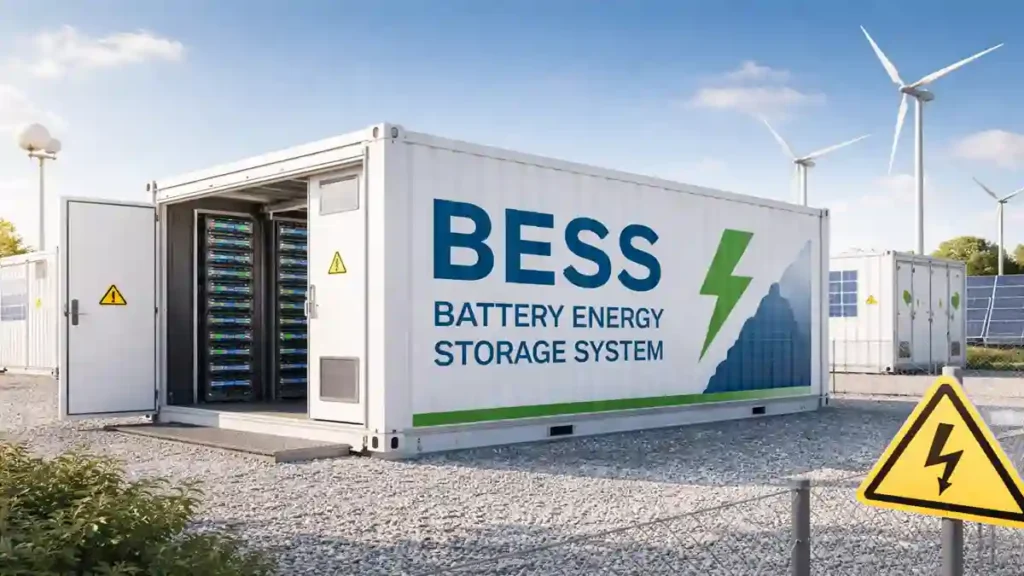
Table of Contents
1. Core Technical Terms & Performance Metrics
To make sound engineering and purchasing decisions, you must first master the key metrics that govern Lithium-ion—specifically Lithium Iron Phosphate LiFePO4—battery. operation.
BATTERY CAPACITY & RUNTIME ANALOGY

A. Power (kW) vs. Energy (kWh)
Power ( kW): Represents instantaneous power capability—how wide the water tap opens. It dictates how many appliances or machines you can run simultaneously.
Energy (kWh): Represents total stored energy volume—how much water is inside the tank. It dictates how many hours your loads can operate.
Example: A 10 kW / 10 kWh battery can power a continuous 10 kW load for exactly 1 hour, or a 1 kW load for 10 hours.
B. State of Health (SOH) & End of Life (EOL)
In Simple Terms: Think of SOH like the battery health percentage on your smartphone. Brand new out of the box, your battery sits at 100 % SOH . Over years of chemical degradation, its total storage capacity slowly shrinks to 90% , 80 % , or lower.
Technical Definition: SOH is the ratio of a battery’s current maximum dischargeable capacity to its original nominal factory rating:
End of Life (EOL) Benchmark: Stationary solar batteries reach their official EOL when SOH drops to 70 % – 80 %. The battery still functions, but holds 20 % — 30 % less backup energy than on Day 1.
C. C-Rating (Charge & Discharge Speed)
In Simple Terms: The C-Rating measures how rapidly energy can be pumped into or drawn out of the battery relative to its total capacity.
1 C Rate: Fully charges or discharges the battery in 1 hour.
0.5 C Rate: Fully charges or discharges the battery in 2 hours.
2 C Rate: Fully charges or discharges the battery in 30 minutes.
Technical Formula:
Current (Amps) = C-Rating X Capacity (Ah)Calculation Example: Discharging a 200 Ah Lithium pack at 0.5 C draws 0.5 X 200 = 100 Amps.
Solar Recommendation: Stationary BESS packs perform best when operated at 0.2 C to 0.5 C continuous rates. High C-rates >1 C create internal resistive heating I2 R losses), accelerating capacity fade.
D. Depth of Discharge (DoD) vs. State of Charge (SOC)
SOC (State of Charge): How full the battery is (e.g., 80 % SOC= 80 % remaining).
DoD (Depth of Discharge): How much energy has been drawn out DoD = 100\% – SOC .
Safe Limits: While old lead-acid batteries could only safely handle 50 % DoD , modern Lithium LiFePO4 cells safely support 80 % to 90 % DoD daily.

2. What Makes Battery Life Increase or Decrease?
Battery aging happens in two ways: Calendar Aging (wear over time regardless of use) and Cycle Aging (wear from charging and discharging).
BATTERY DEGRADATION FACTORS
Factors That DECREASE Battery Lifespan:
Operating in High Ambient Heat >350C: Heat is the number one killer of Lithium-ion cells. Operating at high temperatures accelerates Solid Electrolyte Interphase (SEI) layer growth inside the cell, causing rapid capacity loss.
Sustained High C-Rates >1 C: Rapid charging or discharging causes internal resistive heating ($ I2 R). During fast charging at low temperatures or high current, lithium plating occurs on the anode, creating microscopic short-circuit hazards (dendrites).
Deep Discharge Cycles 100 % DoD : Repeatedly draining cells down to 0 % SOC causes mechanical strain and lattice disruption in the cathode structure.
Sitting at 100% SOC for Long Periods: Storing a battery continuously fully charged at elevated temperatures increases internal electrolyte oxidation.
Factors That INCREASE Battery Lifespan:
Operating in the Optimal Temperature Range 150 C to 250 C .
Limiting Depth of Discharge to 80 % DoD (keeping SOC between 10 % and 90 %.
Maintaining Moderate Charge/Discharge Speeds 0.2 C to 0.5 C.
Sizing with an Aging Buffer 15 % – 20 % extra capacity so cells are never over-stressed.
3. Battery Sizing Spectrum: Undersizing vs. Oversizing Impact
Properly sizing a BESS for a solar plant requires balancing Capital Expenditure (CAPEX) against Operational Lifespan (OPEX). Deviating too far in either direction creates significant engineering and financial drawbacks.
BESS SIZING SPECTRUM & IMPACTS
UNDERSIZED BESS
[ Too Small Capacity ]- Frequent High C-Rate Discharge
- Thermal Stress & Accelerated Wear
- Clipped / Wasted Solar Energy
- Risk of Deep Discharge (<10% SOC)
OVERSIZED BESS
[ Too Large Capacity ]- Low C-Rate Discharge (Gentle)
- High Upfront CAPEX
- Long Idle Periods at High SOC
- Chronically Undercharged if Solar Small
A. Undersizing the Battery: Impacts & Consequences
Undersizing happens when the battery capacity ($\text{kWh}$) or power output ($\text{kW}$) is too small for the connected load demand or solar PV array output.
1. High C-Rate Strain & Thermal Degradation
A smaller battery must work disproportionately harder to supply the same load, forcing it to run at a high C-rate.
Scenario Comparison 20 kW continuous load):
Optimally Sized 40 kWh Battery):
Discharge Rate = 20 kW/ 40 kWh = 0.5 C quad (2-hour discharge; gentle on cells)Undersized 10 kWh Battery:
Discharge Rate = 20 kW/10 kWh = 2.0 C (30-minute discharge; severe stress)Result: Running continuously at 2 C produces severe internal thermal stress, driving down cycle life from 6,000 cycles to under 2,500 .
2. Wasted Solar Energy (Solar Clipping)
When peak sunlight occurs, an undersized battery reaches 100 % SOC almost immediately. Any remaining solar generation that cannot be consumed on-site or exported to the grid must be curtailed (wasted).
3. Deep Discharge Strain
Undersized batteries undergo multiple full discharge cycles 100 % DoD daily, triggering early mechanical degradation of active cell materials.
B. Oversizing the Battery: Impacts & Consequences
Oversizing occurs when installed storage capacity far exceeds daily backup requirements or daily solar recharge capability.
1. High Upfront CAPEX & Poor ROI
Batteries represent the highest line-item expense in an energy storage system. Oversizing increases project payback periods exponentially without delivering tangible benefits.
Example: Installing a 100 kWh container for a facility that only requires 25 kWh of nightly backup quadruples upfront battery costs unnecessarily.
2. Chronic Undercharging & Cell Drift
If a large battery is paired with a small solar array, the solar panels cannot generate enough energy to fully recharge the battery daily. Hovering continuously between 30 % and 50 % SOC prevents the Battery Management System (BMS) from performing passive cell balancing, leading to cell voltage drift over time.
3. High SOC Stagnation (Calendar Aging)
If an oversized battery sits fully charged at 100 % SOC for extended idle periods without substantial daily drawdown, high internal cell voltage accelerates electrolyte oxidation.
C. Comparative Sizing Summary Matrix
| Parameter | Undersized Battery | Optimal Sizing | Oversized Battery |
| Operating C-Rate | High >1C to 2C | Balanced 0.2C to 0.5C | Very Low <0.1C |
| Thermal Strain | High (Requires active cooling) | Low to Moderate | Minimal |
| Solar Utilization | Low (Solar energy clipped/lost) | High 95 %+ captured) | High (If solar array is large enough) |
| Expected Lifespan | Shortened 3 – 5 years | Maximized 10 – 15 years | High Calendar Life (Poor Payback) |
| CAPEX Efficiency | Low (Early replacement cost) | Optimal | Poor (Excessive initial outlay) |

4. Battery Management System (BMS): The Electronic Brain
A Lithium-ion cell cannot operate safely without a Battery Management System (BMS). The BMS is an automated electronic controller that constantly monitors and protects the battery pack.
Key Functions of the BMS:
Cell Balancing: Ensures all individual cells in a string maintain identical voltage levels, preventing weaker cells from overcharging or over-discharging.
Thermal Protection: Derates (throttles) or cuts off current if internal temperatures cross safe limits >500 C or 00C.
Overcurrent & Surge Cutoff: Opens high-power MOSFETs or contactors if peak load currents exceed safe continuous or pulse limits.
SOC & SOH Estimation: Uses Coulomb counting and voltage algorithms to report live state-of-charge and capacity health to the solar inverter via CAN/RS485 communication protocols.
5. BESS Warranty Void Conditions: When Is Warranty Denied?
BESS manufacturers offer 10 -year performance warranties, but these warranties contain strict operating guardrails. A manufacturer can inspect BMS log data and void your warranty under the following conditions:
BATTERY DEGRADATION FACTORS
Top 5 Conditions That Void Your Battery Warranty:
Thermal Abuse (Over-Temperature Logs): BMS log data showing cumulative operating hours above maximum temperature limits (typically >500 C to 550 C due to inadequate ventilation or HVAC failure.
Open-Loop / Unapproved Inverters: Connecting the battery pack to an inverter that lacks active BMS-to-Inverter closed-loop communication, leading to unmanaged charge profiles.
Deep Discharge Neglect: Draining the battery to 0 % SOC and leaving it uncharged for months. Parasitic draw and self-discharge drag cell voltages below critical recovery thresholds <2.0 V/cell, causing permanent copper dissolution.
Environmental Violations: Outdoor installation without proper IP-rated protection against moisture ingress, direct rainfall, or salt-mist atmospheric corrosion.
Exceeding Throughput Limits: Warranties specify a term of 10 years OR a maximum total energy throughput limit (e.g., 30 MWh total delivered energy per 10 kWh module), whichever comes first.

6. Quick Buyer & Installer Checklist
Before purchasing or commissioning a BESS, verify your design against this reference checklist:
| Feature | Recommended Target Parameter |
| Cell Chemistry | LiFePO4 (Lithium Iron Phosphate) for maximum thermal safety and cycle life |
| Daily DoD Limit | 80 % to 90 % Depth of Discharge |
| Operating C-Rate | 0.2 C to 0.5 C Continuous 1C maximum peak pulse) |
| Cycle Life Rating | > 4,000 to 6,000 Cycles at 250 C |
| Inverter Closed-Loop Protocol | Active CAN-bus / RS485 Communication |
| Aging Margin Buffer | Include +15 % to +20 % extra capacity for 10-year SOH capacity fade |
| Warranty Terms | 10-Year Warranty with 70 % – 80 % Retained SOH |
The Bottom Line: Why Precision Sizing & Partner Selection Matter
Choosing an incorrectly sized battery energy storage system carries far-reaching consequences: undersizing forces high C-rate operation, causing severe thermal stress, solar clipping, and premature capacity fade, while oversizing locks up unnecessary upfront capital, leads to high-SOC stagnation, and risks cell drift from chronic undercharging. Ultimately, the true value and long-term return on investment of a solar BESS project depend on striking a precise balance between peak load demands, depth of discharge, and future aging margins. Partnering with the right vendor and selecting a high-quality, fully compatible battery product guarantees closed-loop BMS communication, proper thermal engineering, and reliable warranty backing—ensuring your energy storage system operates safely, efficiently, and dependably for its entire 10-to-15-year operational lifecycle
